NAADAM FESTIVAL
NAADAM FESTIVAL
Naadam is Mongolia’s most important national festival, celebrated across the country every year from July 11 to 13. The festival centers on the Three Manly Games: wrestling, horse racing, and archery.
- Origin and History
The origins of the Naadam Festival date back to the era of the Xiongnu Empire, around the 1st–2nd centuries BCE, when a unified state emerged. During this time, the Xiongnu people organized competitive games to strengthen unity among tribes and develop the military skills of their warriors. Over time, these activities evolved into what are now known among Mongolian peoples as the Three Manly Sports. Historical records, including The Secret History of the Mongols, note that these competitions were traditionally held in July, a month once known as “Khuransar.”
In 2003, Mongolia adopted the Law on the National Naadam Festival, formally establishing the celebration at national, provincial, and local levels. In 2010, Naadam was inscribed on UNESCO’s Representative List of the Intangible Cultural Heritage of Humanity.
- Horse Racing
Mongolian horse racing is a long-distance event that emphasizes endurance rather than speed alone. The fastest and strongest horses are carefully selected and trained weeks in advance through daily riding and controlled feeding. Horses compete according to age and are raced over distances ranging from 10 to 30 kilometers. The six age categories are stallion, mature horse, three-year-old, two-year-old, yearling, and foal. The jockeys are usually children aged 6 to 8.
Prizes are awarded to the first five finishers, a tradition known in Mongolian as Airagiin Tav (“the Five of Airag”). A special award called Bayan Khodood is also given to the horse that finishes last, offering a blessing that it will place first in the following year. During the award ceremony, a caller (mori tsollooch) announces the winning horses and riders, and traditional praises or poems may be recited to honor their success. This ritual is believed to celebrate and extend good fortune for both the horse and the young jockey, while also publicly recognizing their achievement in front of the crowd.
- Wrestling
Mongolian wrestling holds a special place in Naadam celebrations. At the national festival, wrestlers with state and provincial titles compete, while regional and district wrestlers take part in local events. Mongolian wrestling follows a single-elimination format, meaning a wrestler is eliminated immediately after a loss, and the competition continues until the top two places are determined. Wrestlers who achieve five or more victories are awarded official titles, reflecting their skill and experience.
The movements of Mongolian wrestling symbolize the strength and grace of powerful animals and birds, such as the eagle, falcon, and the mythical garuda. Traditional wrestling attire includes a hat, an open-front jacket (zodog), shorts (shuudad), boots, and boot straps, making the sport visually distinctive. During matches, a referee known as a zasuul assists the wrestler and announces the wrestler’s title after the 3rd round. This announcement is believed to honor the wrestler’s achievements and boost their spirit and confidence.
- Archery
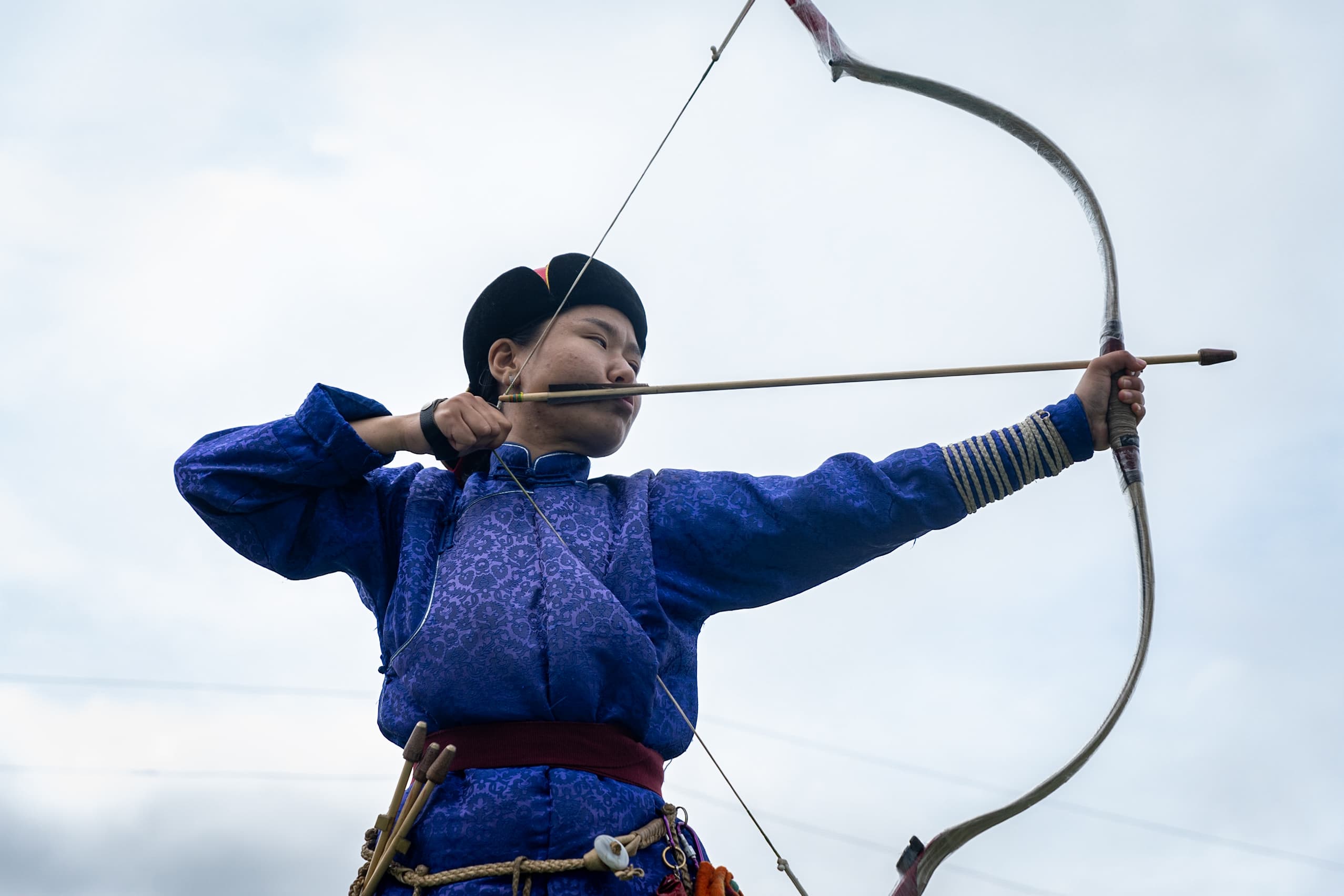
Archery is another ancient Naadam sport with deep historical roots. Archers shoot at targets made of small leather cylinders called sur, stacked in rows at a distance of about 75–80 meters. Competitions are held for both men and women, and archers wear traditional Mongolian deel.
Archers take turns shooting while spectators encourage them with traditional calls of “khurai,” an expression of praise and encouragement. Skilled competitors are awarded honorary titles and decorations in recognition of their precision and mastery. Like the Naadam Festival itself, Mongolian archery was inscribed on UNESCO’s Representative List of the Intangible Cultural Heritage of Humanity in 2010.
- Naadam Cuisine
Khuushuur is a popular traditional food enjoyed during Naadam. It is a fried meat pastry made from wheat flour dough, folded around minced mutton or beef and seasoned with onion and salt, sometimes with garlic or pepper, before being pan- or deep-fried.
Airag (fermented mare’s milk) is also widely consumed during the festival. Mongolians have a long tradition of fermenting mare’s milk in summer and autumn. The milk is poured into a leather bag and churned 2,000–3,000 times to ferment properly. Airag has a slightly sour taste and naturally contains carbonation, along with vitamins and minerals, including vitamins A, D, E, and K.
About the Author
You might also like
View all tips →No related tips found.