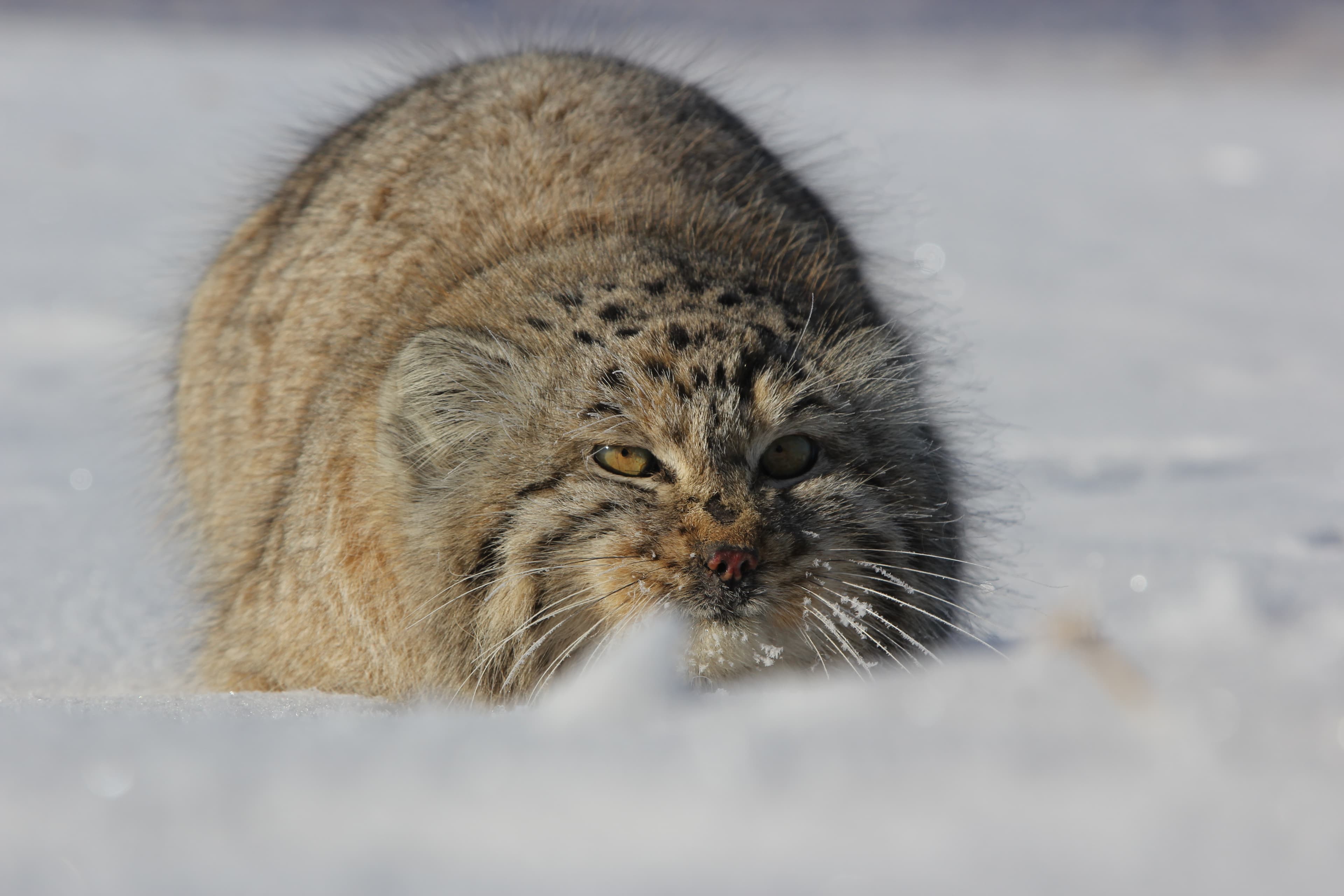
Pallas's Cat (Manuul)

Gantigmaa Gantulga
Manager
The Pallas's cat (Otocolobus manul) is a small wild cat native to Central Asia. It is approximately the size of a domestic cat, with a body length of around 60 cm, a tail measuring about 25 cm, and an average weight of 3.6 kg.
Its fur is reddish-brown with subtle vertical stripes, although these markings are often difficult to see because of its exceptionally thick coat.
Pallas's cats have several distinctive features that set them apart from other wild cats. One of the most interesting is their round pupils, unlike the vertical pupils found in many other small cat species. They also have short, stocky legs and long, dense fur. Their coat changes with the seasons: in winter, it becomes greyer and its markings become less noticeable. Their low-set ears give them a distinctive appearance, sometimes resembling those of an owl.
Pallas's cats inhabit the steppes and mountainous regions of Asia, generally at elevations of around 1,000–4,000 metres above sea level.
Global Distribution
Pallas's cats are found across several countries in Central and South Asia, including Russia, Armenia, Iran, Kazakhstan, Uzbekistan, Afghanistan, Pakistan, Tajikistan, China, India, Kyrgyzstan, and Mongolia.
Distribution in Mongolia
In Mongolia, Pallas's cats are distributed across almost all regions except the taiga forest zone. They are particularly common in the mountainous areas of Khuvsgul and Khentii, as well as in the provinces of Arkhangai, Zavkhan, Gobi-Altai, Khuvsgul, and Tuv. They can also be found in the steppe regions of Dundgovi, Sükhbaatar, and Khentii, as well as the eastern Mongolian plains. They are less commonly found in the Trans-Altai Gobi, the Junggar Gobi, and the southern Gobi regions. They are also rare in desert habitats.
Behaviour and Lifestyle
Pallas's cats are primarily active at dusk and during the night. They are solitary animals and lead secretive lives, making them difficult to spot in the wild. Their mating season usually takes place in February, during the spring breeding period. The gestation period lasts approximately 65–67 days, after which a female typically gives birth to between three and six kittens. They reach sexual maturity at around two years of age and can live for up to 10 years in the wild.
Diet
Pallas's cats are carnivores that mainly feed on small mammals, including:
- Brandt's voles
- Gerbils
- Pikas
- Hamsters
- Ground squirrels
They also occasionally prey on young marmots, baby hares, partridges, and other small birds.
Conservation Status
The Pallas's cat is listed as Near Threatened on the International Union for Conservation of Nature (IUCN) Red List. Its survival is affected by habitat degradation, declining prey populations, and other environmental pressures.
About the Author
Hello! I’m Gantigmaa. I grew up in the Mongolian countryside, surrounded by livestock and nature. Now, I work in tourism, helping travelers plan their trips and discover the beautiful, hidden corners of my home country.
You might also like
View all tips →No related tips found.